Plan for an episode
A clinician may teach selected patients an appropriate vagal manoeuvre and explain when it is safe to try. Emergency treatment should not be delayed when symptoms are severe.

Supraventricular tachycardia care in Shanghai
Supraventricular tachycardia, often called SVT, describes several rapid rhythms that begin above the ventricles. Care starts by documenting the rhythm, identifying its likely mechanism and understanding how often it occurs, how it affects the patient and which treatment approach is appropriate.
← Return to Dr. Ouyang’s profile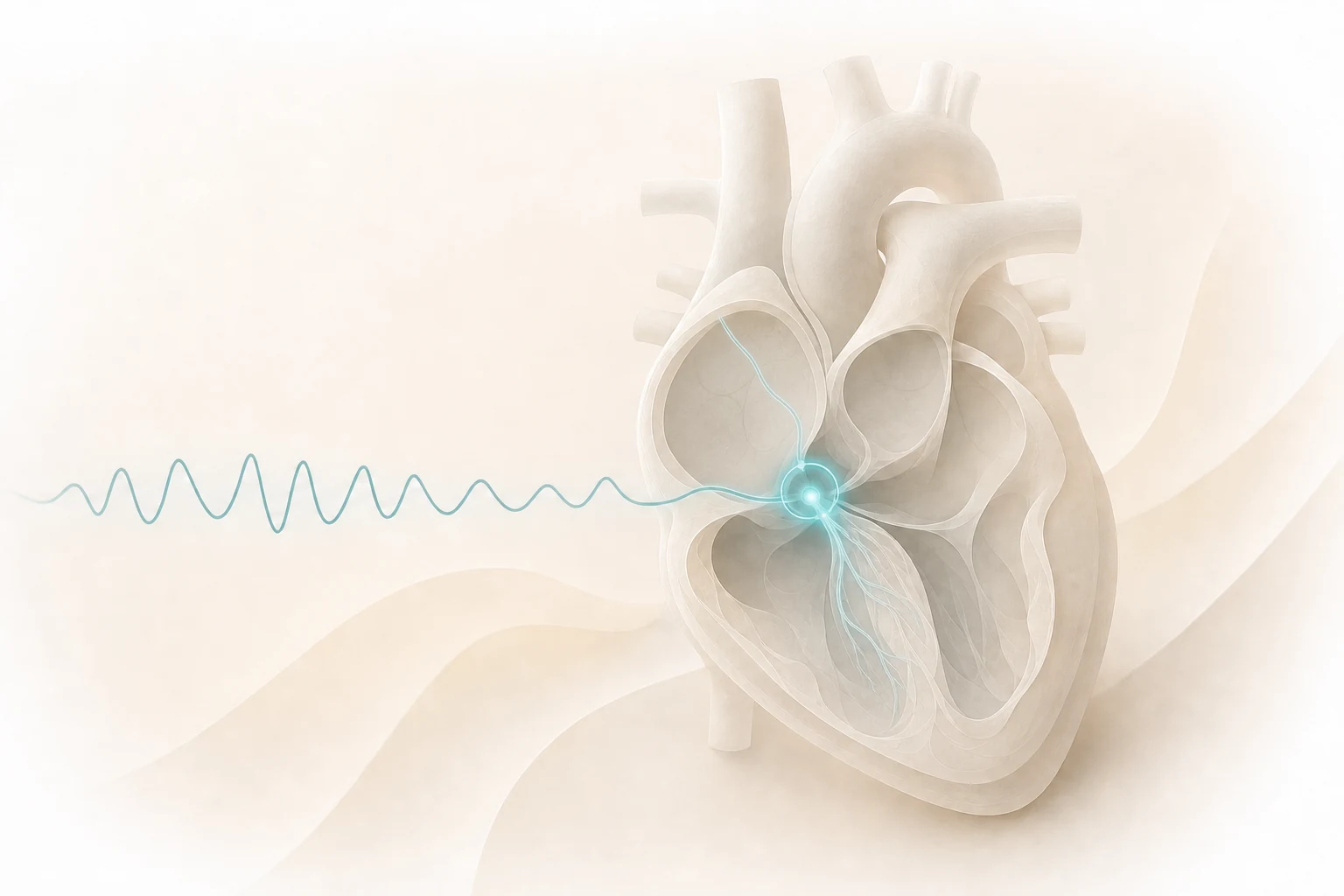
Understanding the condition
Supraventricular tachycardia is an umbrella term for rapid heart rhythms that begin in the atria or around the electrical connection between the atria and ventricles. Common mechanisms include atrioventricular nodal re-entrant tachycardia, atrioventricular re-entrant tachycardia involving an accessory pathway and focal atrial tachycardia.
Episodes often begin and end suddenly. They may last seconds, minutes or longer, and the heart rate can be much faster than usual. Some people experience occasional episodes with limited impact, while others have frequent or prolonged symptoms that interfere with daily life.
Because a fast heartbeat can have several causes, symptoms alone cannot confirm SVT. Whenever possible, the rhythm should be captured on an ECG, ambulatory monitor, wearable recording or another clinician-reviewed tracing.
Symptoms and urgency
The experience depends on the rhythm rate and duration, the person’s age, heart condition and other medical factors. Some episodes are mainly uncomfortable; others require urgent assessment.
A rapid, pounding or fluttering heartbeat that may start and stop abruptly.
Dizziness, weakness or feeling close to fainting.
Shortness of breath, chest discomfort or reduced exercise tolerance.
Fatigue, sweating, anxiety or a pulsing sensation in the neck.
Specialist assessment
A specialist review considers how episodes begin and end, symptom pattern, rhythm recordings, medicines, other health conditions and any evidence of structural heart disease.
Individualized treatment
Some people need only observation and a clear action plan. Others may discuss medication, catheter ablation or a combination of approaches.
A clinician may teach selected patients an appropriate vagal manoeuvre and explain when it is safe to try. Emergency treatment should not be delayed when symptoms are severe.
The assessment may consider medicines, stimulants, thyroid function, electrolyte disturbance and other conditions that can influence the heart rate or symptoms.
Medication may be appropriate in some cases. The choice depends on the SVT mechanism, other medical conditions, potential side effects and patient preference.
For many recurrent SVTs, ablation can target the electrical pathway or focus responsible for the rhythm. The expected benefit and risks should be discussed individually.
Rhythm-control treatment
This information is general. Only a clinician who has reviewed the individual case can advise whether a procedure is appropriate.
The ablation strategy differs for AV nodal re-entry, an accessory pathway and focal atrial tachycardia. Rhythm recordings and the electrophysiology study guide the plan.
Ablation may be discussed when episodes are frequent, prolonged, difficult to tolerate or significantly affect work, exercise, travel or quality of life.
Some patients prefer a procedural strategy, while others consider ablation because medication has not controlled symptoms or has caused unwanted effects.
A specialist should explain the intended target, expected likelihood of control, procedural risks, recovery and the possibility that the rhythm may recur or a second procedure may be needed.
Specialist experience
Dr. Ouyang’s clinical career has focused on cardiac electrophysiology, complex arrhythmias and catheter ablation. His experience includes the evaluation and ablation of atrial and ventricular tachyarrhythmias and leadership in high-volume electrophysiology practice.
View Dr. Ouyang’s experiencePreparing for a consultation
The care team will explain how to share records securely. Do not send medical attachments through the initial website form.
ECGs recorded during symptoms, ambulatory-monitor reports, wearable recordings and the dates and duration of episodes.
Current and previous medicines, emergency treatments, prior electrophysiology studies or ablations and relevant side effects.
Echocardiogram or other relevant reports, medical conditions, family history and a short description of symptoms and goals.
Frequently asked questions
These answers provide general education and do not replace an individual medical assessment.
No. Both begin above the ventricles, but they have different electrical mechanisms and rhythm patterns. Learn more in the atrial fibrillation patient guide.
No. SVT begins above the ventricles, while ventricular tachycardia begins in the lower pumping chambers. The distinction affects urgency, evaluation and treatment.
Some episodes stop spontaneously. A clinician may teach appropriate patients a vagal manoeuvre, but severe symptoms or a persistent rapid heartbeat may require urgent medical treatment.
Ablation is an established treatment for several common SVT mechanisms. Whether it is appropriate depends on the documented or suspected rhythm, symptoms, medical background and patient preference.
That depends on the rhythm mechanism, result of the procedure and other heart conditions. The treating team should provide an individualized plan.
A 12-lead ECG during the rapid rhythm is especially valuable. Monitoring reports and suitable wearable recordings may also help when a full ECG is unavailable.
Request specialist care
Share basic contact information and the SinoUnited international care team can help coordinate the next appropriate step with Dr. Ouyang’s service.
Clinical references