Observe and follow
When evaluation is reassuring and symptoms are limited, a clinician may recommend education, follow-up and attention to relevant triggers.

PVC assessment in Shanghai
Premature ventricular contractions, commonly called PVCs, are early beats that begin in the lower chambers of the heart. The important questions are how often they occur, whether they cause symptoms, what pattern they follow and whether the heart is otherwise healthy.
← Return to Dr. Ouyang’s profile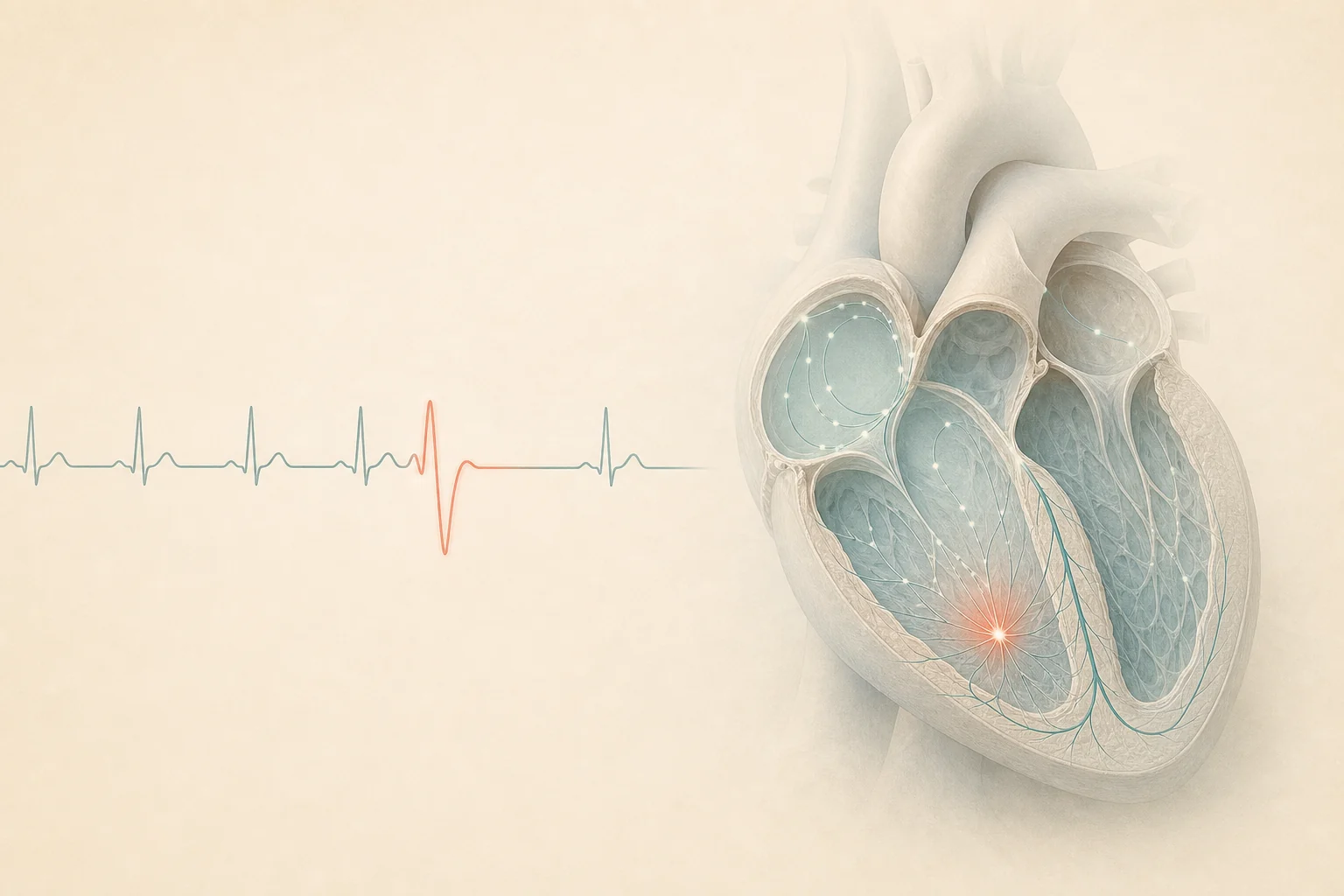
Understanding the rhythm
A premature ventricular contraction is an early electrical activation that starts in a ventricle, one of the heart’s lower pumping chambers. The early beat is often followed by a pause, which can make the next normal beat feel unusually strong. Patients may describe this as a skipped beat even though an extra early beat has actually occurred.
Occasional PVCs can occur in people without known heart disease. Their clinical importance varies widely. A specialist considers the number of PVCs, whether they share one pattern or arise from several sites, their relationship to exercise, the symptoms they cause and whether there is evidence of structural heart disease.
PVCs are not the same as sustained ventricular tachycardia. A PVC is an isolated early ventricular event, although repeated ventricular beats can sometimes occur in pairs, short runs or more sustained rhythms. The actual tracing is important when defining what has been recorded.
Symptoms and urgency
Some people have frequent PVCs without feeling them. Others notice even occasional beats. Symptoms do not always reflect the number of PVCs, so rhythm monitoring can add useful objective information.
A pause, flip-flop or sudden stronger heartbeat.
Thumping, pounding or irregular beats in the chest or neck.
Fatigue, breathlessness or reduced stamina in some patients.
Dizziness or near-fainting should be discussed promptly with a clinician.
Specialist assessment
A rhythm specialist reviews the tracing rather than relying only on the sensation of skipped beats. The assessment aims to confirm that the beats are ventricular, quantify them and determine whether further heart evaluation is needed.
Individualized treatment
Treatment is guided by symptoms, PVC burden, heart function, suspected origin and the patient’s preferences. Observation can be appropriate in some cases; active treatment is important in others.
When evaluation is reassuring and symptoms are limited, a clinician may recommend education, follow-up and attention to relevant triggers.
Sleep, stimulants, alcohol, tobacco, medicines, electrolyte abnormalities and other conditions may be reviewed when relevant.
Medication may be discussed for bothersome symptoms or selected clinical situations, with benefits and side effects considered individually.
Frequent PVCs can sometimes contribute to reduced heart function. Monitoring burden and ventricular function helps guide whether more active treatment is warranted.
Rhythm-control treatment
This information is general. Only a clinician who has reviewed the individual case can advise whether a procedure is appropriate.
Ablation may be considered when PVCs cause significant symptoms and a procedural approach is appropriate after discussing alternatives.
When frequent PVCs are suspected of contributing to reduced ventricular function, reducing the burden can become an important treatment goal.
The ECG pattern helps estimate the PVC origin. An electrophysiology study maps the focus, but some locations are more complex or carry different procedural considerations.
A specialist should explain the expected benefit, alternatives, procedural risks, possibility that PVCs are infrequent during the procedure and the potential for recurrence.
Specialist experience
Dr. Ouyang’s clinical and academic work has included mechanisms, mapping and catheter ablation across complex ventricular arrhythmias. For PVCs, careful documentation and assessment of heart structure come before deciding whether treatment is necessary.
View Dr. Ouyang’s experiencePreparing for a consultation
The care team will explain how to share records securely. Do not send medical attachments through the initial website form.
12-lead ECGs showing PVCs, ambulatory-monitor reports with PVC burden and symptom diaries or relevant wearable recordings.
Echocardiogram, cardiac MRI or other imaging reports, exercise-test results and relevant diagnoses.
When symptoms occur, current and previous medicines, possible triggers, family history and any prior ablation or emergency assessment.
Frequently asked questions
These answers provide general education and do not replace an individual medical assessment.
People often experience a PVC and the following pause as a skipped beat. The rhythm actually contains an early ventricular beat, followed by a pause and sometimes a stronger normal beat.
Many PVCs are not dangerous, but their significance depends on burden, pattern, symptoms, heart function and any underlying disease. A tracing and clinical assessment are needed for an individual answer.
PVC burden is the proportion of recorded heartbeats that are PVCs during a monitoring period. It is one part of assessment and should be interpreted with symptoms, morphology, heart function and monitoring duration.
In some people, a high PVC burden can contribute to reduced ventricular function. Clinicians consider this possibility when PVCs are frequent and heart function is otherwise unexplained.
Yes, catheter ablation may be appropriate for selected symptomatic patients or when PVCs are suspected of affecting heart function. Suitability depends partly on the origin and frequency of the PVCs.
A 12-lead ECG showing the PVC morphology and an ambulatory-monitor report showing burden are particularly helpful, together with imaging and a complete medication history.
Request specialist care
Share basic contact information and the SinoUnited international care team can help coordinate the next appropriate step with Dr. Ouyang’s service.
Clinical references